14 · The foundation and the five living specs¶
← 13 The add command reference · Contents · Next: 15 Foundations and lineage →
The engine needs ground¶
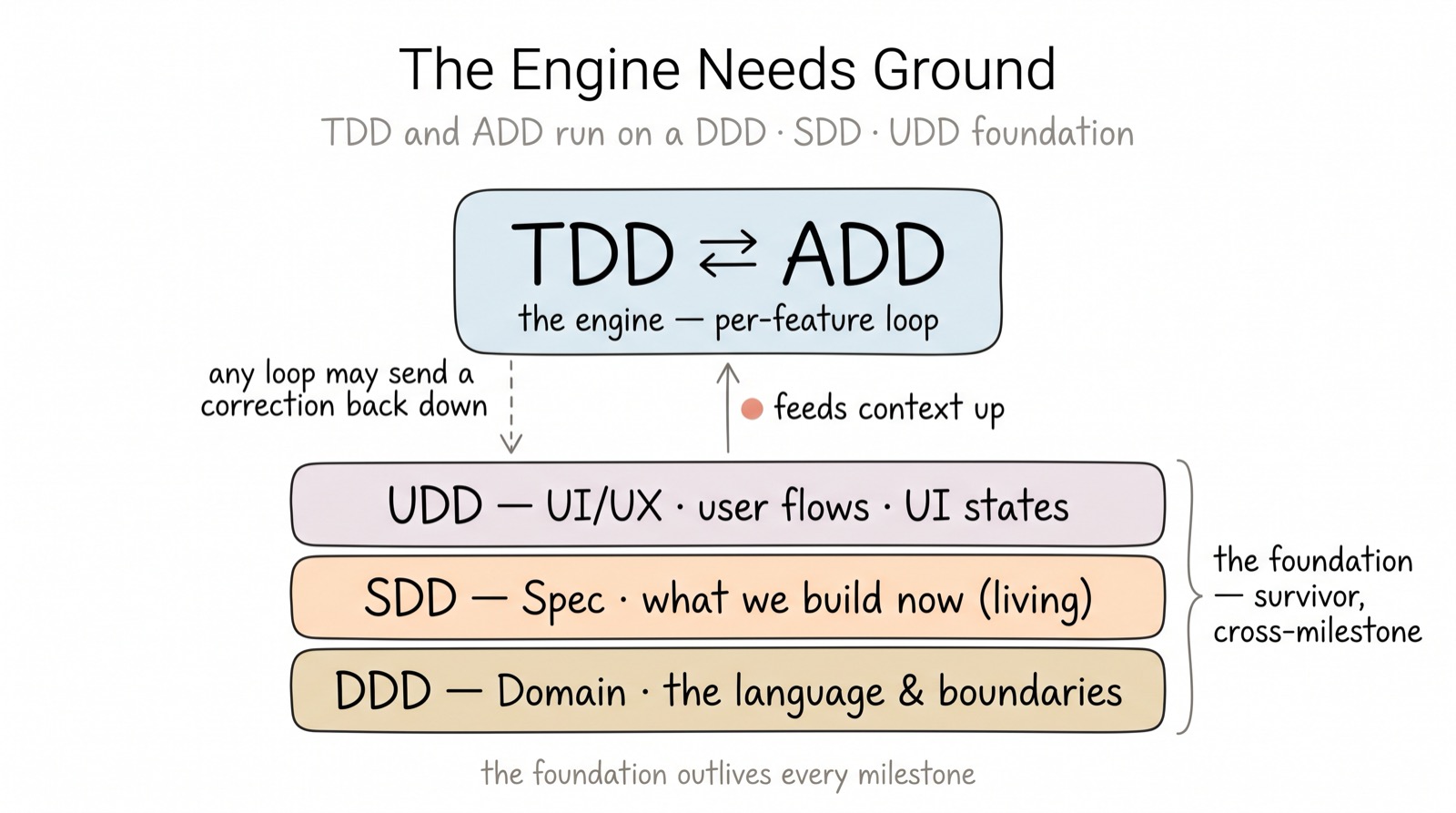
The three-beat loop in Part II is the engine: Direction (rules · plan · red checks) → Build → Verify, run as a tight loop. TDD and ADD turn inside that engine — author the failing check, let the AI generate code to green, repeat.
But an engine needs something to stand on. Every loop quietly assumes context that no single task owns: what the words mean, what we are building right now, and how its users experience it. When that context lives only in someone's head, each new session — and each new milestone — starts cold, and the AI fills the gap with plausible guesses. That is the same failure the method exists to prevent (00), one level up.
The foundation is the layer that holds this context and outlives every milestone. It is not new ceremony; it is the living documentation the method already names, made explicit as five living specs.
Three concerns, one foundation¶
-
DDD — Domain. The shared, precise language and the boundaries it lives in: the core concepts, the contexts they belong to, and the invariants that must always hold — the domain model behind the names. One name per concept — the same names the spec, the contract, and the code all use. (The GLOSSARY holds the full term list; the foundation holds the model those terms describe.)
-
SDD — Spec. The living document. What is being built right now and what is settled versus still open. This is not a frozen plan written once — it is the layer that changes as the loop learns (01). In ADD it does not duplicate the work; it points to the active milestone and the frozen contracts that other tasks build against.
-
UDD — UI/UX. Users use the interface, not the spec. The experience designed before code: the user flows (happy and alternative paths), the UI states every screen must handle (loading · empty · error · success), and a design source of truth. The AI can generate a prototype from a design system; a person owns the empathy — what the user is trying to do, and what "good" feels like from their side. The checks (Direction) test that behaviour; the foundation keeps the design intent that makes a screen worth building.
These three concerns are the foundation the engine stands on. Together with the TDD ⇄ ADD engine of Part II, they are ADD's five competencies. The first four feed context to the fifth, where the AI executes on it:
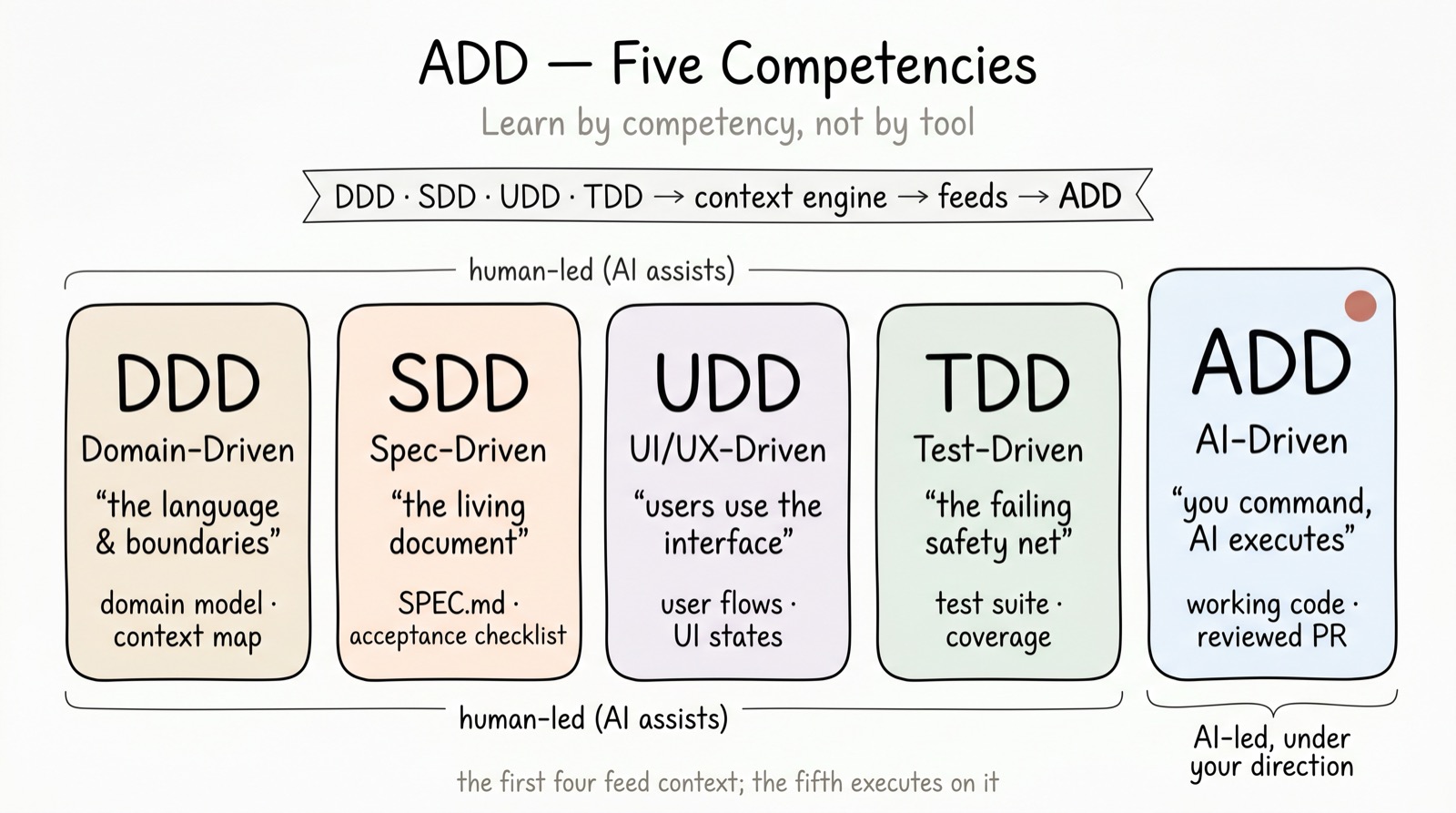
The diagram's foundation (DDD · SDD · UDD) and the method's own words — living documentation · the foundation · ubiquitous language — name the same three ideas. This chapter is where the diagram and the text finally meet.
A thin index over living specs¶
A foundation that takes a week to write is a foundation no one keeps current. So
ADD keeps it thin and split: a single .add/index.md project card that every
session reads first, pointing into the five living specs under .add/specs/
where the standing picture actually lives — one file per competency, the same file
lessons land in as the loop learns.
.add/index.md                   — the project card, read first
  goal · invariants             — the bundle's standing direction
  sensitive_paths:              — the paths that pin the authority floor (§ governance)
  a compiled map into .add/specs/ and the active milestone

.add/specs/                     — the standing 5-DD picture (lessons land here)
  domain.md      (DDD)  — concepts · contexts · invariants
  system.md      (SDD)  — the spec stance: settled vs still open, architecture, conventions
  experience.md  (UDD)  — UI/UX: user flows · states · design intent
  quality.md     (TDD)  — testing + quality conventions
  method.md      (ADD)  — the loop and gate rules the engine runs on
Each spec has the same three sections — a ## Now standing picture, a
## Decisions that bind ledger (the one section a compiled brief may cite), and a
## Deltas inbox where each new lesson prepends. Keep index.md to one screen: the
goal, the invariants: every task must hold, the sensitive_paths: floor, and the
pointers. The detail lives in the specs (and, past one screen, in a milestone or a
frozen contract), never relocated back up. You do not hand-write the whole thing:
at setup the AI drafts the foundation — silently from an existing codebase, or
from a short interview on a greenfield repo — and seeds the five specs; a single
human confirms that draft as committed direction (the setup-level analog of a
contract freeze). add learn <lens> then streams each loop's lessons straight into
the matching spec's ## Deltas, so the picture stays current without a separate
write-up.
How it feeds the engine — and takes feedback back¶
The arrow runs both ways, which is the whole point of a re-entrant method:
- Down → up. At the start of any session or milestone, read
index.md(and, through its pointers, the.add/specs/picture) before touching a task. It is the cheapest way to point the AI in the right direction.add statusprints a pointer to the foundation for exactly this reason. - Up → down. When a loop reveals that the domain model was wrong, the spec stance has shifted, or a user assumption did not survive contact with reality, you stop and update the foundation — then come forward again. A passing check built on a broken foundation is still the wrong software, fast.
Where it sits in the hierarchy¶
The foundation is the Project tier of the node hierarchy
(12 · The .add/ bundle) — created once, kept for the
life of the product, owned above any single milestone.
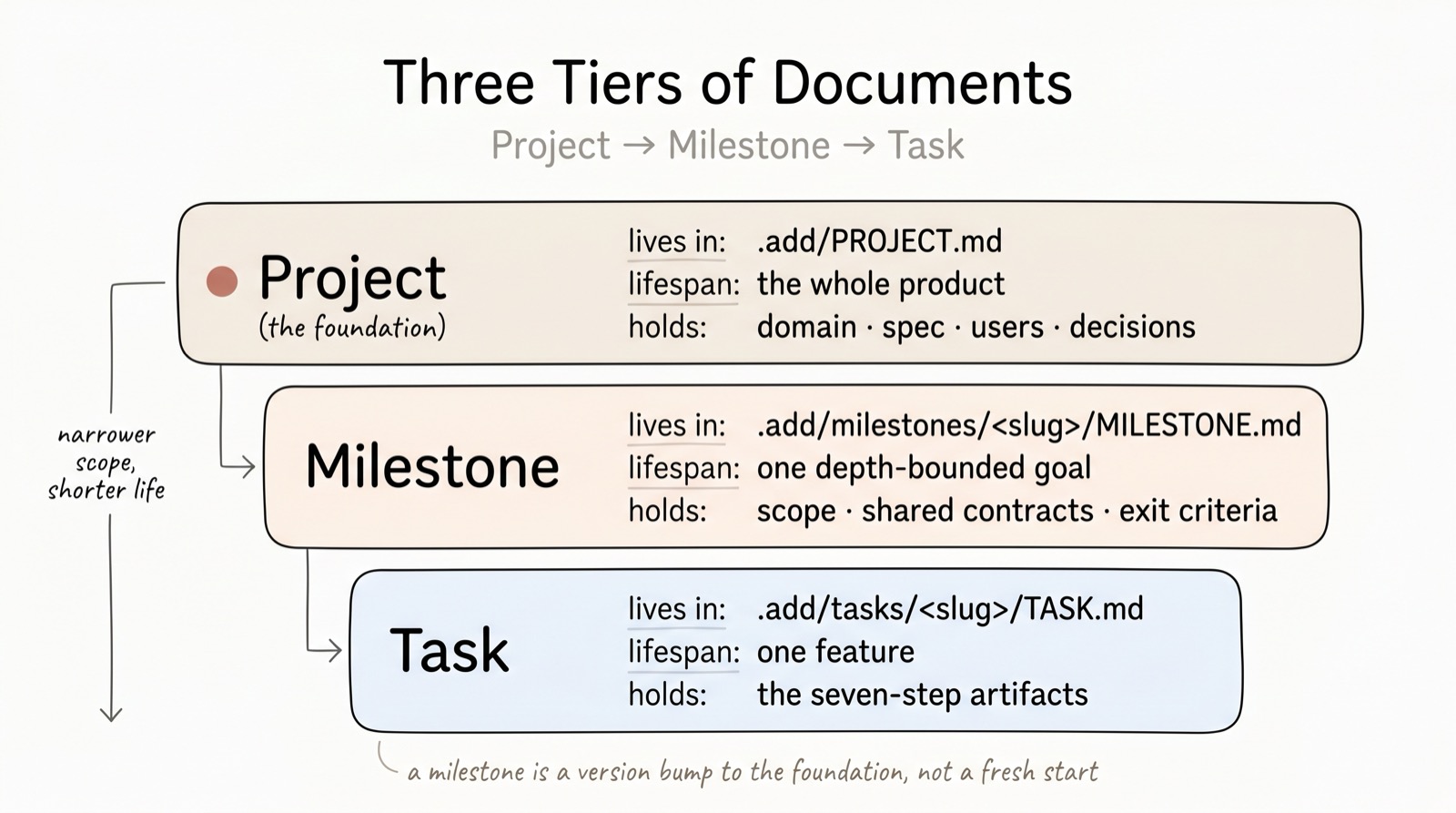
| Tier | Lives in | Lifespan | Holds |
|---|---|---|---|
| Project (foundation) | .add/index.md + .add/specs/ |
whole product | invariants · decisions + the 5-DD standing picture (domain · spec stance · users · quality · method) |
| Milestone | .add/milestones/<slug>.md |
one depth-bounded goal | scope · shared ground · exit criteria (CARD · SCOPE · GROUND · EXIT · CLOSE) |
| Task | .add/tasks/<slug>.md |
one feature | one atomic node (CARD · RULES · PLAN · CHECKS · EVIDENCE · LESSONS) |
A milestone is a version bump to the foundation, not a fresh start: when it
closes, consolidate what it validated into the .add/specs/ foundation (a settled
domain term into domain.md, a spec-stance shift into system.md, a confirmed user
journey into experience.md) — and open the next one against the same, now-richer,
ground. The consolidation is not informal: each loop emits lessons (tagged
ddd · sdd · udd · tdd · add) as they land, and at milestone close a person gathers
the open ones and folds them — into the matching spec's ## Now /
## Decisions that bind, never clobbering what is there. See
06 · The loop
for the grammar, the ritual, and the tooling (add deltas, add fold).
In the tooling¶
add initscaffolds the bundle: theindex.mdproject card and the five.add/specs/files as living-doc seeds; the AI then drafts their content and a single human confirmation freezes it as committed direction. Like every living-doc file,initnever overwrites a hand-edited one.add statusshows a one-line pointer to the foundation, so a fresh session re-orients on context before code.- The guideline block written into
CLAUDE.md/AGENTS.mdtells any agent the same thing: runstatus, read the foundation, then work the loop.
The thesis, one level up. The engine builds the thing right; the foundation keeps the engine pointed at the right thing — across every milestone, not just the current one.